
The three-tier, school-based emergency mechanism for students
Disclaimer: The following article discusses issues surrounding suicide. If you are struggling and require immediate assistance, please call 999 for emergency services, or look here for other hotlines and resources.
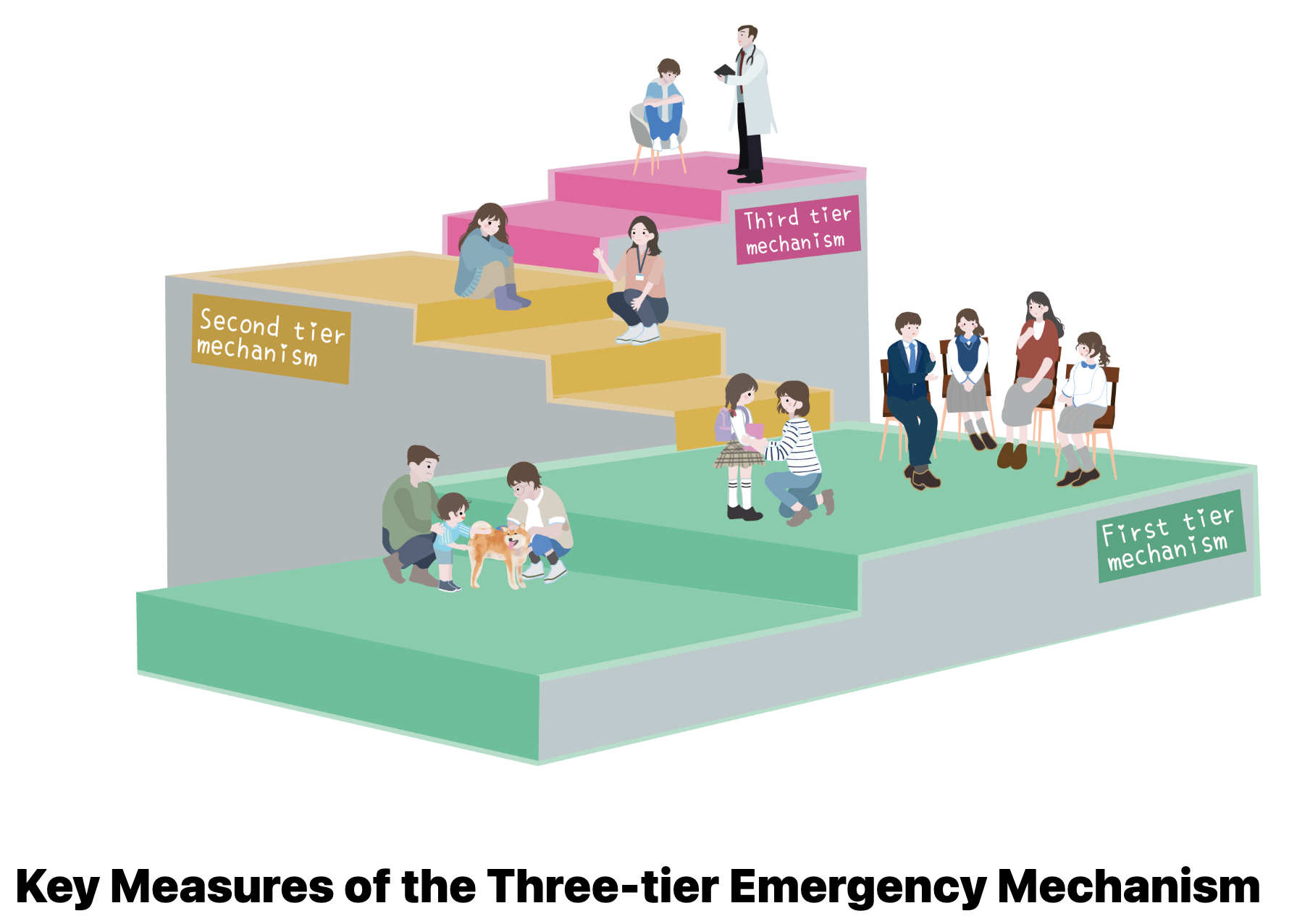
Read more about the three-tier emergency mechanism here. (Image credit)
In Hong Kong, young people face significant pressures from academic demands, family expectations, and social changes. When these challenges contribute to suicidal thoughts or behaviours, early coordinated action can make a life-saving difference. Recognizing this, the Education Bureau (EDB), in partnership with the Health Bureau and Social Welfare Department (SWD), introduced the Three-Tier School-Based Emergency Mechanism to strengthen schools’ ability to identify and support students at higher suicidal risk. This is distinct from the three-tiered stepped care system for children and youth, which is another pathway for students in need of other mental support to receive help from school or from external experts.
Launched in all secondary schools in December 2023 and regularized from 1 December 2025, the mechanism has now been extended on a trial basis to upper primary levels (P4–P6) from 1 December 2025 to 31 August 2026 (now further extended on a trial basis for the 2026-2027 school year). This initiative builds a robust safety net through close collaboration among schools’ multi-disciplinary teams, off-campus support networks, and specialist medical services, ensuring no student in distress is left unsupported.
Understanding the Three-Tier School-Based Emergency Mechanism
The mechanism follows a stepped approach that matches the level of risk with appropriate support. It emphasizes early identification, off-campus intervention, and medical referral across tiers:
First Tier – In-School Support (Early Identification and Immediate Response): Schools activate their multi-disciplinary teams — including guidance teachers, school social workers, and educational psychologists, to detect and assist students showing higher suicidal risk. The school might arrange for the use of mental health screening tools to assess needs across the entire school year, and provide priority counselling or other forms of support to the student. The goal is to intervene as early as possible within the familiar school environment.
Second Tier – Off-Campus Support (Enhanced Short-Term Intervention): When a student needs additional reinforcement beyond school resources, they may be referred to the regional off-campus support teams coordinated by the Social Welfare Department (SWD), after receiving parents/guardians’ consent. These teams will deliver emergency assessment, individual or group counselling (including online options), or connect the student with additional support from other community services. Close communication with the school ensures consistent follow-up during this critical period.
The regional off-campus support team include the following:
St. James’ Settlement’s 6pm Cyber Youth Support Team (for Hong Kong Island)
Caritas Hong Kong’s Infinity Teens - Cyber Youth Support Team (for East Kowloon)
The Boys’ & Girls’ Clubs Association of Hong Kong’s Nite Cat Online – Cyber Youth Support Team (for West Kowloon)
Hong Kong Children & Youth Services’ eSm^_^iley Cyber Youth Support Team (for New Territories East)
The Hong Kong Federation of Youth Groups’ uTouch Cyber Youth Outreach Service (for New Territories West)
Third Tier – Medical Referral (Specialist Psychiatric Care): For students assessed as high risk, the school principal makes a direct referral to the Hospital Authority’s psychiatric specialist outpatient services with parental/guardian agreement. The parents/guardians will then accompany the student to the outpatient services, and school personnel can also accompany the student (alongside parents/guardians) as necessary to provide more information during the triage process. The Hospital Authority applies triage to prioritize urgent cases. Importantly, even while awaiting specialist appointments, the student continues to receive ongoing Tier 1 and/or Tier 2 off-campus assistance to maintain safety and continuity of care.
*In emergency situations or when a student poses an immediate risk, the school should activate its crisis management procedures and either contact the police for assistance or arrange urgent transfer of the student to a hospital for treatment.
Recognizing Warning Signs and Taking Action
Early detection is crucial. According to the EDB’s Resource Handbook, over 80% of suicides are preceded by observable warning signs. Common indicators include:
Expressions related to death or suicide: Talking or writing about wanting to die, seeking lethal means, or making final arrangements.
Mood and emotional changes: Persistent sadness, irritability, hopelessness, guilt, or emotional numbness.
Behavioural shifts: Withdrawal from friends and activities, declining academic performance, changes in sleep or eating patterns, truancy, self-harm, or risky behaviours.
Physical or cognitive signs: Fatigue, poor concentration, sense of being a burden, or loss of motivation.
Teachers and parents are encouraged to observe daily interactions, listen actively without judgment, and ask directly about suicidal thoughts when concerns arise. If signs persist or intensify, schools should promptly consult their guidance team and activate the appropriate tier of the mechanism. Identifying both the risk factors (such as family discord or previous self-harm) and protective factors (strong school connectedness, supportive relationships, and healthy coping skills) can also provide a clearer picture for tailored support.
How the Mechanism Works in Practice
Scenario 1 with Tier 1 intervention: The school conducts a school-wide survey at the start of school year, assessing general information that reveal students’ risk factors (ex. no friends, financial pressures at home). A student reports high stress levels from academic performance. Their subject teacher also notices recent behavioral changes in the student and raises it with the guidance team. After further assessments indicating stress and anxiety surrounding school work, the student receives priority counselling sessions at school. The family is supported to understand the situation and are connected to additional psychoeducational resources, preventing escalation.
Scenario 2 with Tier 2 intervention: A student exhibits self-sabotaging behavior in class, coinciding with recent poor school performance. The school’s internal team initiates support but decides additional help is needed as the student frequently reports a sense of hopelessness. The off-campus team is then contacted, and a external social worker responds with emergency assessment and short-term counselling, while coordinating closely with the school social worker for ongoing monitoring of the student as well. Additional community and school support resources are provided for the student to learn about coping skills and to help with school performance as well.
Scenario 3 with Tier 3 intervention: A student shares with the school social worker about self-harm incident, and reports having thoughts of committing suicide soon (but not immediately). The school’s internal team discusses with the parents of the student, and the principal then completes an urgent referral to Hospital Authority psychiatric services. The student is accompanied by their parents and the school social worker, and is assigned priority care for psychiatric services within one week. After providing sufficient care to the student, the hospital provides a report for the school to follow-up on the student’s situation, ensuring long-term safety.
You Are Not Alone – Help Is Available
While the school-based emergency mechanism provides excellent crisis response targeting levels of needs, many students and families also benefit from ongoing, individualized therapeutic support from external organizations. Private counsellors can:
Offer confidential sessions that build emotional regulation, resilience, and coping skills.
Support parents and siblings who may also be impacted by the student’s situation.
Help bridge the gap during waiting periods for specialist services or out-of-school hours.
Facilitate smoother re-integration into school after any crisis or hospital involvement.
Suicidal risk in young people is serious, but with early identification, coordinated school support, and professional care, recovery is possible. The Three-Tier School-Based Emergency Mechanism reflects Hong Kong’s commitment to protecting our children and youth. If you are a parent, teacher, or caregiver concerned about a student’s wellbeing, trust your instincts and reach out promptly. Following government recommendations, schools have clear pathways in place, and additional counselling support can make a profound difference in students’ mental health management and recovery.
If you would like to learn more about how a counsellor can help with your child’s mental health growth, enquire here for a session with Compassionate Minds.
